
It is not luck and it is not the moves. The dance people describe as the reason they keep coming back is the one where two people spend the whole song reacting to each other instead of performing at each other. We can be that blunt about it because we counted.
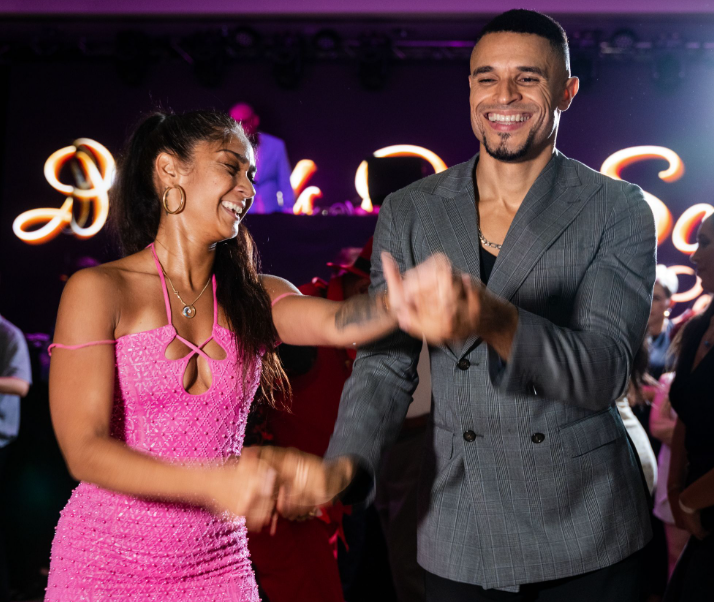
I film social dance floors for Social Dance TV: most of a festival weekend, I watch dancing through a viewfinder instead of doing it. You can see this moment from across a room, with the music too loud to think in. It almost never belongs to the couple doing the biggest thing. The tell is stillness in the faces, not ecstatic, not performing, just absent, while the feet keep going. Two people stop scanning the room. That is the whole visual signature, and it lasts one song.

for those five minutes, the world simply doesn't exist. It's pure soulemating, that deep connection of souls
— a dancer on Reddit r/Salsa, November 2025
That was posted under a thread titled “Salsa, a lonely introvert’s dream activity.” Soulemating is their typo and their word. We keep both.
Seven moments in everything we read came out at the very top: the strongest things anyone wrote, in either direction. Four of them are people describing happiness. The five minutes above are one of them.
What are they actually describing?
It is not a mood but something two people do to each other, and the posts and comments we read are unusually consistent about it. The bluntest version of how it breaks comes from a 2016 teacher post on the Salsa Souls blog:
It's astounding how few people on the Salsa dance floor actually watch each other and react to each other. Most of them just chuck their moves around.
— “How to become a desirable Salsa social dancer”, Salsa Souls, 2016
Dancers say the same thing without the diagnosis. Memorised repertoire “keeps you in your head instead of being in the moment”. “I’ll choose an enthusiastic beginner over a person with lots of moves”. A ballroom follow quotes the mantra drilled in class: “Stop thinking! Stay in the moment. Feel me. Listen to what my body is saying. Just react...Don’t anticipate anything!”
Both roles describe the same handover from opposite sides. A lead on dance-forums.com describes the goal as getting to “turn off” the follow’s brain, so the dance can run on feel, “That can only happen if the follower has enough trust”. On English-speaking Reddit, a 33-year-old follow describes the other end of it: it has been “really healing being able to let go of control and trust a lead to take care of me in a dance”.
Trust comes first. The peak is what it buys. Which is why the most useful line we found puts the burden somewhere specific: “The dancer with the higher level of consciousness bears the responsibility to make the dance a good dance”. Not the better dancer. The one who noticed first.
The compliment that tells you it happened
Dancers already have a way of confirming it, nineteen years old. September 2007, salsaforums.com, a thread on the best compliment anyone had received:
The best compliment ever: It is so easy to dance with you!
— salsaforums.com, September 2007
When a person has enjoyed a dance at the same time that I have that is my best compliment. I need nothing else.
— salsaforums.com, September 2007
In June 2026, on the same forum, someone posted a satirical nine-level ladder of dancing ability: “Level 1 - you go to parties, shake your ass to salsa and feel good... Level - 9 you shake your ass at the salsa music and everyone feels good.” Nineteen years, two generations of one forum, the same answer with the pronoun moved.
The part worth noticing: in all 39 posts and comments we read on this, not one treasured compliment names a move, a spin or a combination. They name ease, mutual enjoyment, and being hugged after a dance by someone you don’t know.
Half of this is teachers, and you should know that
We are not going to pass a teachers’ canon off as what everyone thinks. Of the 39 posts and comments behind this section, 20 come from two teacher-written articles, the Salsa Souls post above and “Keys to Being Pleasant on the Dance Floor” on Dance Drills. The other 19 come from sixteen individual posters across three forums. More than half of the scene’s written articulation of the great dance was written by people who teach it for a living.
That is not a scandal, and the teacher material is often good. It supplies the practical version: open with simple elements, a cross-body lead, a turn under the arm, the first things anybody learns, because that is how you “establish our small talk”. The same genre also produces this:
Your energy and passion will be contagious, making the dance more enjoyable for everyone involved.
— “Keys to Being Pleasant on the Dance Floor”, Dance Drills
That could sit on any school’s homepage and it tells you nothing. Which is why we quote dancers where we can. The line teachers and dancers reach independently is the keeper: social dancing “wasn’t about looking good; it was about feeling good”.
Why doesn't it happen more often?
Because most dances are not that, and the people who wrote to us are honest about it. An experienced lead admits that with familiar partners it turns into a “when is this song ending?” feeling. The teacher post names the same drift: you dance along “from one partner to the next, without ever reaching any depth”.
What the evidence does not support: that the peak belongs to advanced dancers. A veteran, on the favourite partner of an entire festival, about two years of dancing, no previous partner-dance background, “But she went all in on the dance floor. Attitude.”
See related articleThe Moment You Become a DancerThe part we cannot film
The honest part: you cannot ask for it. In nine years of filming I have never once produced this moment by pointing a camera at it, and I have ended plenty. On English-speaking Reddit, dancers say exactly how: “It’s so hard to relax and forget people are watching whilst seeing a camera pointed at me”, and “It feels like I have to perform... I just want to have a moment with someone”.
So our practice here is subtraction. Wide, from distance, no light in anybody’s eyes; no walking into a couple for a better angle on something that is only happening because nobody is watching; a head shake ends it, no negotiation. The footage of a good dance worth keeping is footage of people who forgot we were there.

What this evidence can and cannot tell you
The connection material is the best-sourced thing we have: 39 posts and articles across three forums and two teaching blogs, 2007 to 2026, no single source supplying more than a third. That is why this piece states it plainly.
Three of those seven strongest moments are not happiness at all, a follow injured by a move never agreed to, and two dancers who did not want a camera on them. They sit in the same count, scored the same way. The good dance is most of the peak, not all of it.
The joy material is weaker and we won’t overstate it. The “why I dance” answers and the healing accounts come overwhelmingly from one platform, English-speaking Reddit, online, self-selected toward people who post. Not a survey, and not the global scene.
One more limit, and it cuts in our favour. What we read is text, and text skews to grievance: this scene discusses etiquette, money and complaint, and upvotes video, people dancing well and looking happy. The happiness mostly doesn’t get written down, so a count like ours under-states it. This is the conservative version of the case.
What does it cost?
Nothing, which is the quiet joke underneath it all. On English-speaking Reddit, in a thread asking why people dance at all, the answers are almost domestic: forgetting a day’s worries for a few hours “for the price of a few drinks”; going home “energised, revitalised, and in a much better mood” after a terrible day; not sharing a language with your partner and not needing to, because “you both know 123 567”, the salsa count said out loud, all the vocabulary two strangers require.
One person in that thread answered in six words.
Because when I dance I'm free
— Reddit r/Salsa, “Why do you dance?”, November 2025
Five minutes, for the price of a few drinks.
See related articleHow to Read a Festival Before You Book ItHow this was made
The figures come from a ledger of 862 community signals drawn from public forum posts, comments and published teacher articles, 283 positive, 304 mixed, 274 negative and one neutral, which is roughly how much this scene agrees with itself. Every record also carries an emotional-intensity score; seven sit at the top of it, and four of those seven are the happiness accounts this piece is built on. Direct author attribution was recovered for 739 signals and 329 individual authors; unresolved or ambiguous records were excluded from author counts. Every signal is linked to a topic cluster and to a numbered record in that ledger, so any line here can be traced to its source. Coding was assisted by AI tools; corpus design, source reading and every editorial judgement in this article were human. Quotes are verbatim and lightly trimmed for length; usernames are not published.